Why the battle for Lord Stanley’s Cup disgraced the game
Last Wednesday night an intriguing NHL regular season and fantastic playoffs (wait, aren’t the Stanley Cup playoffs always fantastic? Yes, pretty much the only sports event in the spring that’s guaranteed, every time. OK, I’m biased, I’m a big hockey fan...anyways) ended in the best possible scenario. After a tenacious six games between one of the storied Original Six’s American franchises and a Canadian city manically and violently desperate for a championship, the Bruins flew back to Vancouver and manhandled the Canucks in front of their stunned home fans.
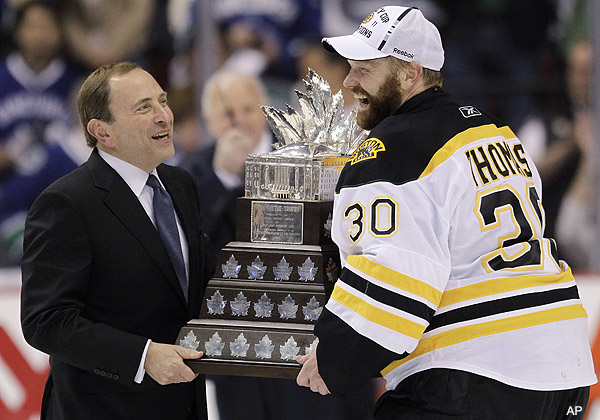
Grizzled veteran Tim Thomas, who played journeyman goalie in the minors and Finland for years until his breakthrough in 2008, peaked at the ideal time for the Bruins: after an amazing regular season where he may very well be awarded the Vezina Trophy again, Thomas had an even higher save percentage and goals-against average while playing every game of the playoffs, and his Finals performance is already legendary. The Conn Smythe winner at 37 years young played the most dominating goalie performance I can recall since my favorite hockey team of all time had Dominik Hasek rack up six shutouts in the 2002 playoffs. Hats off to Thomas, and to the effort of the Bruins defensively in denying the high-powered Canucks offense, led by those freaky Swedish twins and Ryan Kesler. It sounds like the best Stanley Cup series of the post-lockout NHL!
Grizzled veteran Tim Thomas, who played journeyman goalie in the minors and Finland for years until his breakthrough in 2008, peaked at the ideal time for the Bruins: after an amazing regular season where he may very well be awarded the Vezina Trophy again, Thomas had an even higher save percentage and goals-against average while playing every game of the playoffs, and his Finals performance is already legendary. The Conn Smythe winner at 37 years young played the most dominating goalie performance I can recall since my favorite hockey team of all time had Dominik Hasek rack up six shutouts in the 2002 playoffs. Hats off to Thomas, and to the effort of the Bruins defensively in denying the high-powered Canucks offense, led by those freaky Swedish twins and Ryan Kesler. It sounds like the best Stanley Cup series of the post-lockout NHL!
 |
| Another save for the indefatigable Thomas |
Unfortunately for hockey fans in most cities besides Vancouver and Boston, this series proved to be a regression and disappointment from so much of the promise and expectation that lay in store for this NHL season. After the fantastic 2010 Olympic gold medal game brought hockey back to the forefront, the Chicago Blackhawks brought the Cup back to Chicago after a fifty-year drought, reinvigorating the most dormant of the Original Six markets. And in the fall, HBO’s fantastic “24/7” miniseries followed the buildup to the Winter Classic between two of the NHL’s most exciting teams and their two superstars of the moment, Ovechkin and Crosby. When I first viewed “24/7” I thought two things:
1. This will actually increase the mainstream popularity of the NHL among casual sports fans! (This didn’t really pan out, although the NHL did have to compete with the best NBA regular season since Michael Jordan.)
2. Despite my love of the Red Wings and the NHL in general, I don’t have the best cable TV package at college to watch the games (no Versus or Fox Sports Detroit) and I thought I would probably just follow from a distance and tune back in for the playoffs. But... the miniseries captivated me. And I don’t even particularly like either team (especially not this annoying *#@$).
So needless to say, I had high hopes for such a promising series between two good markets and the two best teams from the East and West. And it didn’t disappoint, it thrilled NHL fans with a quicksand-paced, idiotic-finger-biting NHL Hitz tribute, exactly what hockey needed. The sarcasm dripping from that last sentence is now pooling on the floor. Gross.
Although the series produced several closely contested finishes, those were all Vancouver wins, and the Boston wins were slaughters where “emo goalie” Roberto Luongo was shell-shocked in the net. We saw acts of despicable sportsmanship go unpunished by the referees, which left the players to “police themselves” with the most penalty minutes in a Stanley Cup Finals in 20 years, and more importantly since the lockout.
After finishing Ken Dryden’s fantastic book, The Game, this summer on my way out to DC, I have to say that while his accounts of life in the NHL are fantastic, the most interesting part of the book was his anthology of play style and violence in the NHL. When Dryden comments in 1983 that “the violence of our game is not so much the innate violence in us as the absence of intervention in our lives. We let a game follow its intuitive path, pretending to be powerless, then simply live with its results”, he touches on the issues that we thought the league had solved after the lockout. Theoretically, hockey should be more fast-paced, skillful and exciting than ever before on the ice, and the hard salary cap unique to hockey has ensured that many teams in the league can be competitive. And the attempts to produce higher scores by the league (and thus, fans) had, again in theory, driven down the ugly violence that chronically weakens hockey.
But while the playoffs have traditionally been the venue for the older, scrappier brand of hockey, I don’t mind that as long as the talent is still on display. This Stanley Cup Finals, the games were still tense and well fought as they always are in the playoffs, but the verbal and physical sparring, combined with the deeply disappointing riots in Vancouver (standing in for Baghdad or Detroit circa 1984) really hurt my enjoyment of the series. Don’t quote me wrong; I love scrappy hockey as much as the next guy: a good fight can be part of the game (man, I wish the Avs were still good so the rivalry would be back). But that does not mean the style of play between the whistles need suffer. And during this series, the fights and penalties and insults overshadowed the games, which just continues to play into the stereotypes the NHL has tried to change since the lockout.
Although the series produced several closely contested finishes, those were all Vancouver wins, and the Boston wins were slaughters where “emo goalie” Roberto Luongo was shell-shocked in the net. We saw acts of despicable sportsmanship go unpunished by the referees, which left the players to “police themselves” with the most penalty minutes in a Stanley Cup Finals in 20 years, and more importantly since the lockout.
After finishing Ken Dryden’s fantastic book, The Game, this summer on my way out to DC, I have to say that while his accounts of life in the NHL are fantastic, the most interesting part of the book was his anthology of play style and violence in the NHL. When Dryden comments in 1983 that “the violence of our game is not so much the innate violence in us as the absence of intervention in our lives. We let a game follow its intuitive path, pretending to be powerless, then simply live with its results”, he touches on the issues that we thought the league had solved after the lockout. Theoretically, hockey should be more fast-paced, skillful and exciting than ever before on the ice, and the hard salary cap unique to hockey has ensured that many teams in the league can be competitive. And the attempts to produce higher scores by the league (and thus, fans) had, again in theory, driven down the ugly violence that chronically weakens hockey.
But while the playoffs have traditionally been the venue for the older, scrappier brand of hockey, I don’t mind that as long as the talent is still on display. This Stanley Cup Finals, the games were still tense and well fought as they always are in the playoffs, but the verbal and physical sparring, combined with the deeply disappointing riots in Vancouver (standing in for Baghdad or Detroit circa 1984) really hurt my enjoyment of the series. Don’t quote me wrong; I love scrappy hockey as much as the next guy: a good fight can be part of the game (man, I wish the Avs were still good so the rivalry would be back). But that does not mean the style of play between the whistles need suffer. And during this series, the fights and penalties and insults overshadowed the games, which just continues to play into the stereotypes the NHL has tried to change since the lockout.
 |
| Typical post-whistle shenanigans There are times where I miss the pre-lockout NHL, but the style of play has definitely progressed and become more open today. With HDTV allowing fans to actually follow the puck without goofy graphics and the in-arena product better than ever, and the exposure the NHL has generated from the Winter Classics, it’s now more important than ever for the NHL and their referees to maintain order on the ice. While the NHL doesn’t have the same trust issues with their referees as other leagues, they need to realize that the playoffs are the time to showcase their product to the world on a larger stage, and if playoff games degenerate into penalty-fueled routs, it will remain the weird cousin of the major American sports leagues. Instead of a breathtaking series capped by a Game 7 that will be talked about for years to come, sports fans wound up with a mostly-forgettable brawl-filled ordeal, which pleased few people besides those pesky Bostonians. It may have been what they wanted, but outside New England, it’s clear that this wasn’t hockey’s finest hour. -The Real Deal |



I like what you guys are doing on here. Nice article and good use of hyperlinks.
ReplyDeleteHowever, on a content note, what the H?! As a hockey fan you should know that the NHL will never compete with the NBA and MLB, exposure-wise...never mind the NFL. It's a niche sport; simple as that. And it isn't because of smack talk – which happens in every sport – or a sometimes intentional check from behind.
Think about all your friends’ favorite sports. What do they all have in common (mostly)...they played them when they were young (or watched them religiously as a kid). And because of this they know the sport’s theory, history and more importantly RULES. I've tried to preach the hockey message to many, many, many people and anyone I didn't convert had the same complaint. "I don't know what's going on. What’s icing? I can't see the black thing; it goes too fast -- it's like soccer and rugby combined."
The physicality and gladiatorial nature of hockey has always been a storied part of our sport, and important to preserve. Yes, the lockout rules helped to allow young talent immediate access to the center stage so 19 year olds can dazzle crowds in the ultimate man's game. Which is good. But the new rules have also pigeonholed the whole league and forced them to play the same type of hockey every game. The new, regulated NHL has lost the raw style of play that famously bruiser clubs like Philly brought to the table. Call me old-fashioned or a bloodthirsty spectator, but I remember when bruisers weren't just a novelty. They were the internal check on checks. Each teams insurance policy for their stars.
I admit the cheap shot aspect of hockey is more brutal than other sports due to the amount of potential weapons each player wields. But, players who want to be malicious from time to time will find a way to do it. More rules are not the answer.
I like to refer to hockey as one of the last “frontier sports.” It’s a sport where vigilante justice and a stigmatic sense of honor must be upheld with a bit of brute force (fights) and public humiliation (embarrassing defeats). Where referees are there to set the boundaries and stay out of the middle. Hey at least with fights, each player knows its coming…kind of like a shootout, no?
Anyway take that for what it’s worth. Keep writing boys. I enjoy your commentary.